


Freight forwarding for Singapore imports and exports
by air and sea
Within a few decades, the city-state at the southern tip of the Malay Peninsula developed into a prosperous international economy. Its strategic position in Southeast Asia has helped make Singapore a major trading centre.
Its port is one of the world’s leading hubs for sea freight and container transshipment. Its location at the southern end of the Strait of Malacca, one of the world’s main maritime trade routes, supports this role. Singapore is also an international hub for air freight. Singapore Changi Airport is a major Southeast Asian gateway.
Your partner for exports, imports, removals and relocation
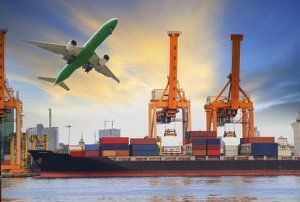 Sea, Air, Transport & Service works with established partners in Singapore. The companies in our network contribute logistics expertise and the standards of reliability, care and coordination that we expect. Together, we develop arrangements for your transport to and from Singapore and for suitable onward connections. Like Hong Kong Singapore is often used as a transshipment point or gateway for cargo with origins or destinations elsewhere in Asia.
Alongside imports and exports we also support international removals to and from Singapore. Many German businesses have subsidiaries, branches or employees in the city-state. Our work covers the transport arrangements and associated handling, documentation and customs coordination.
Sea, Air, Transport & Service: a plan for your shipment
 Draw on our experience. Our team will answer your questions and help assess your requirements. Contact us using the enquiry form, by telephone or by email. Once we know the goods, collection and delivery locations and deadlines, we can prepare an individual quotation and explain the next steps.
Singapore: historical economic figures

- in 2013, Singapore generated GDP of around US$320 billion with a population of about 5.5 million;
- the earlier overview cited per-capita income of US$53,000 and placed Singapore among the ten wealthiest countries, ahead of Germany. This is historical context, not a current ranking;
- imports and exports are central to Singapore’s economy; the foreign-trade ratio was reported at 263% of GDP in 2013;
- the overview identified Malaysia, China, Hong Kong and Indonesia as major export partners, and China, Malaysia, the United States and South Korea as major import partners;
- German exports to Singapore were reported at €1.7 billion in 2013, with German imports from Singapore at €5 billion. These figures are retained as the earlier overview’s historical data;
- the stock of German direct investment in Singapore was reported at €12.1 billion in 2012.
Selected airports and seaports serving Singapore
| Airport / seaport | IATA code / UN/LOCODE | City |
| Singapore Changi Airport | SIN | Singapore |
| Port of Singapore | SG SIN | Singapore |
01. Need a quotation?
Benefit from our experience with transport to and from Singapore.
Our local partner network supports a plan tailored to your shipment and delivery requirements.
02. What do you need?
Germany–Singapore trade lane: seaports, air gateways and transit planning
Singapore is an important trade and transshipment partner for Germany in Southeast Asia. A large share of the containers handled in its port are transferred to other vessels. On the sea freight route, containers may depart from Hamburg or Bremerhaven for Singapore, where PSA’s operations are being progressively consolidated at Tuas. The existing overview gives indicative port-to-port transits of 3.5–5.5 weeks, often around 4.5 weeks. The current service, transshipment and operating conditions determine the actual transit. For urgent goods, air freight through Frankfurt (FRA) and Singapore Changi (SIN) is another option. A nonstop flight itself takes roughly 12.5 hours, while the existing end-to-end planning range is 3–6 days; neither is a delivery guarantee. Whether you need a consolidated LCL (German)shipment or a full container as FCL (German), we select the gateway and transport mode according to the value, volume and required delivery date of your goods.
Customs and origin: using the EU–Singapore Free Trade Agreement correctly
The EU–Singapore Free Trade Agreement (EUSFTA) entered into force on 21 November 2019. Preferential treatment depends on the goods meeting the agreement’s rules of origin and the relevant tariff provisions. The prescribed origin declaration can be made on an invoice or another suitable commercial document; an EUR.1 movement certificate is not the agreed proof. For EU consignments of originating products above €6,000, the exporter generally needs REX registration and must include its REX number. At or below that value, an exporter may make the declaration without REX registration. For goods incorporating non-originating materials, an ordinary certificate of origin (German) does not by itself establish preferential origin; the applicable product-specific origin rule and the correct commodity code (German) must be checked. Singapore’s dutiable categories include intoxicating liquors, tobacco, motor vehicles and petroleum products, including relevant biodiesel blends. Other goods may be non-dutiable but can still attract GST. Import GST is generally 9% of the customs value, including applicable duties, subject to the relevant rules and exemptions. Eligible GST-registered businesses may recover input tax under IRAS conditions. Duty and GST are suspended while qualifying goods are stored in a Free Trade Zone; local release can trigger tax and duty obligations.
Frequently asked questions
How long does sea freight from Germany to Singapore take?
The existing overview gives an indicative 3.5–5.5 weeks from Hamburg or Bremerhaven, often around 4.5 weeks port-to-port. The actual carrier service, routing, transshipment and operating conditions must be confirmed. Air freight through Frankfurt may be suitable for urgent goods, with the complete collection, flight, customs and delivery schedule checked separately.
Do I need an EUR.1 for preferential exports to Singapore?
No. The EUSFTA uses an origin declaration on an invoice or another qualifying commercial document, not EUR.1. For EU consignments of originating goods above €6,000, the exporter generally needs REX registration. At or below €6,000, an exporter may make the declaration without REX registration, provided the goods and declaration satisfy the agreement.
Are imports into Singapore subject to customs duties?
Many industrial and consumer goods are non-dutiable, but GST may still apply. The general import GST rate is 9%, with the customs value and applicable duties included in the taxable value, subject to the relevant exemptions and schemes. Alcohol, tobacco, motor vehicles and petroleum products are dutiable categories. The exact classification, valuation and treatment must be checked for each shipment.
Telephone: +49 (0)89 1250 30 790